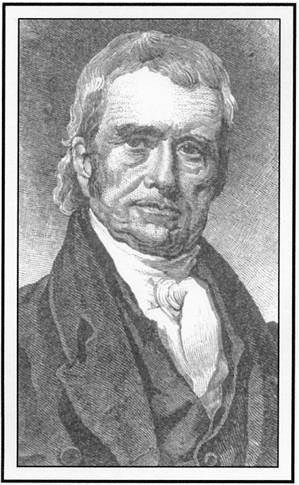
John Marshall
WWW.FAIRAMENDMENT.US
| NEWS |
John Marshall
Judicial power, as contradistinguished from the power of the laws, has no existence. Courts are the mere instruments of the law, and can will nothing. … Judicial power is never exercised for the purpose of giving effect to the will of the judge; always for the purpose of giving effect to the will of the legislature; or, in other words, to the will of the law. (Osborn v. Bank of the United States, 22 U.S. 866)
“A constitution intended to endure for ages to come, and, consequently, to be adapted to the various crises of human affairs.” … [That passage] does not contain the most distant allusion to any extension by construction of the powers of Congress. Its sole purpose is to remind us that a constitution cannot possibly enumerate the means by which the powers of government are to be carried into execution. … The [Supreme Court’s] power of deciding in a last resort, all questions “arising under the constitution and laws” of the United States … cannot be the assertion of a right to change that instrument. (John Marshall’s defense of McCulloch v. Maryland, ed. Gerald Gunther, pp. 185, 209)
What do gentlemen mean by a strict construction? If they contend only against that enlarged construction which would extend words beyond their natural and obvious import, we might question the application of the term, but should not controvert the principle. (Gibbons v. Ogden, 22 U.S. 188)
There is certainly a medium between that restricted sense which confines the meaning of words to narrower limits than the common understanding of the world affixes to them, and that extended sense which would stretch them beyond their obvious import. There is a fair construction which gives to language the sense in which it is used, and interprets an instrument according to its true intention. It is this medium, this fair construction that the Supreme Court has taken for its guide. (John Marshall’s defense of McCulloch v. Maryland, ed. Gerald Gunther, p. 92)
The intention of the instrument must prevail; … its provisions are neither to be restricted into insignificance nor extended to objects not comprehended in them nor contemplated by its framers. (Ogden v. Saunders, 25 U.S. 332, a rare dissenting opinion by Marshall)
Back to
the Fair Construction Amendment